

Male Infertility Factors
Male infertility at a glance:
- The male partner can be responsible for up to half of all cases of infertility.
- Low sperm production, misshapen or immobile sperm, or blockages that prevent the delivery of sperm are common factors in male infertility.
- Men may be born with problems affecting their sperm, or have issues that develop later in life from illness, injury or lifestyle.
- Semen analysis can be performed to determine the possible causes of male infertility.
- Abnormal hormones inhibit sperm production in about 10 percent of infertile males.
- A man’s fertility may decline after age 40.
What are male infertility factors?
According to the National Institutes of Health, male factors are solely responsible for about a third of infertility cases in couples. Male infertility is a contributing cause, along with female factors, in another third of infertility cases. Altogether, male infertility is a factor in two thirds of fertility cases. For these reasons, we think it is prudent to involve the male partner in the evaluation from the outset.
The best predictor of a man’s reproductive potential is his past performance. However, if it has been several years since the birth of his last child, a man’s fertility potential may have changed.
Initial testing for men is quite simple. We take a brief history and perform a semen analysis using strict morphology, which is the size and shape of sperm.
Jon’s Journey to Fatherhood
Like many couples having trouble conceiving, Jon and Wendy assumed that the problem was with her.
Their Story
Causes of male infertility
Male infertility may be caused by a variety of factors, including anatomical problems, issues with the shape, amount, or activity level of sperm, and the age and/or lifestyle of the man. Many couples have no known cause of their infertility, a condition known as unexplained infertility. Recurrent pregnancy loss may also be caused by genetic abnormalities that are passed through the man’s sperm.
Genetic causes
Chromosomal abnormalities can be carried by one or both of the prospective parents and passed on to the developing embryo, which could cause a miscarriage. Translocation, a chromosomal abnormality that occurs when chromosomes break and connect with other chromosomes, is the most common genetic cause of infertility in men.
Genetic abnormalities can be detected by a blood test called a karyotype. It’s important to remember that a successful prior pregnancy does not prove either parent is free of translocations that could affect a future pregnancy.
Microdeletions of the Y chromosome (MDY), also known as Deleted in Azoospermia (DAZ), abnormalities can lead to dramatic reductions in sperm production. The Y (male) chromosome carries certain genes which are essential for sperm production. If there are mutations in these genes sperm production can be absent or very low.
Another genetic abnormality is Klinefelter’s syndrome, in which the male carries an extra X chromosome. Klinefelter’s syndrome can sometimes cause an absence of sperm production and other reproductive problems in the male.
Men who have Noonan syndrome may also experience infertility. This rare syndrome is characterized by short stature, webbed neck, low set ears, and cardiovascular abnormalities.
Environment and lifestyle factors
Sperm quality and quantity can be diminished by certain health and lifestyle factors, such as smoking, alcohol and drug use. Heavy marijuana use can decrease sperm counts. Men who have been exposed to environmental toxins, including pesticides and lead, may also have infertility issues.
Fortunately, sometimes a man can improve his chances of having healthy sperm with some simple lifestyle and behavioral changes.
Injury
Injury to the testicles can have an adverse effect on sperm production. The exposed position of the testicles makes them more susceptible to accidental trauma. An injury or even surgery on the testicles may interfere with their blood supply, thus reducing the growth and maturation of sperm.
Age
Age is also a factor that can influence a man’s fertility. The American Society for Reproductive Medicine recommends that sperm donors be “ideally less than 40 years of age to minimize the potential hazards of aging.” While men can produce sperm throughout their life, increasing evidence suggests that children fathered by older men may have a higher risk of birth defects and developmental disorders.
Hormonal disorders
In normal circumstances, sperm production is triggered by hormonal secretion from the hypothalamus, pituitary gland and testes. These hormones must also work on the testicular tissue that performs actual sperm production. Abnormal hormones that inhibit the process occur in about 10 percent of infertile males, a condition that may be treatable by a doctor.
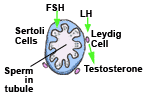
The principle hormones involved in sperm production are FSH (follicle stimulating hormone) and testosterone. If either of these two hormones is deficient, sperm counts can fall. It is critical to note that a man with low testosterone who is trying to achieve pregnancy should not take testosterone as a medication. For testosterone to promote sperm production, it must be produced by the testicle. Testosterone supplements decrease the amount of FSH a man produces and sperm counts usually suffer.
Medications
As stated above, testosterone supplements may substantially decrease sperm production. Medications to increase urinary flow can cause a condition called retrograde ejaculation, in which sperm travel to the bladder rather than out the penis. Calcium channel blockers (frequently used to treat high blood pressure) may inhibit a sperm’s ability to fertilize.
Cancer patients who receive radiation and/or chemotherapy can suffer non-reversible damage to sperm production. We advise patients to consider storing sperm prior to certain cancer treatments.
There are many other medications that can cause problems with sperm production or function. Patients should inquire with their physician or a Reproductive Endocrinologist if they are uncertain about the effects of a particular medication on sperm.
Anatomic disorders
Dilated blood vessels in the testicle, varicoceles, can cause overheating and lead to a reduction in sperm count, motility and reduce the number of normally shaped sperm. Varicoceles can also lead to low testosterone production.
Cryptorchidism is an anatomic cause of infertility, referring to boys born without their testicles fully descended from their scrotum. Sperm production is often deficient after puberty if the condition is not corrected medically or surgically early in life.
About 10 percent of men with infertility issues produce sperm normally, but an obstruction in the genital tract, such as a vasectomy, blocks the sperm from traveling from the testes into the ejaculate. This also may be surgically corrected.
Other obstructions in the genital tract may be caused by the absence of the vas deferens – the duct that transports the sperm from the testicles to the penis. This issue is usually associated with cystic fibrosis. Infections can also block the sperm ducts, but surgical treatment may allow normal ejaculation to occur.
Medical conditions contributing to male infertility
Many medical conditions including chronic illness, liver, kidney or heart disease can impair sperm production. Common conditions leading to low sperm count, though are obesity and diabetes.
Obesity, and the excess body heat it produces, can cause the testicles to overheat. Sperm production and testosterone production can suffer dramatically.
Diabetes can leave to nerve damage and cause retrograde ejaculation, a condition in which the sperm travels into the bladder rather than out the penis.
Who is at a higher risk for male infertility?
Men with a history of traumatic brain injury, radiation or chemotherapy, low libido (sex drive), low energy, diabetes, or a history of pelvic surgery (even in childhood) are at an increased risk for male factor infertility, and should be evaluated promptly.
If there is an identifiable cause of male factor infertility, correction may be advised, if possible. In many of these cases, referral to an urologist is warranted.
However, many times there is not an identifiable cause. In these cases intrauterine insemination (IUI), in vitro fertilization (IVF) or donor sperm may be appropriate.
Sperm production requires the proper function of a part of the brain called the hypothalamus, the pituitary gland and the testicle. Disruption at any level can dramatically alter sperm production.
Similarly, anatomic defects can occur, which block the passage of sperm out of the penis. Just because a man produces an ejaculate does not mean there is sperm. Finally anti-sperm antibodies can be present, making the available sperm less motile.
 |
The hypothalamus secretes a hormone called GnRH to stimulate the pituitary. |
|
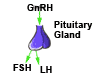 |
In response to GnRH, the pituitary releases FSH and LH. |
|
 |
|
|
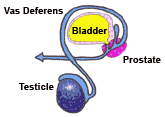 |
Sperm travel through the epididymus, vas deferens, and prostate gland, and out the urethra. |
|